fleet safety AI implementation checklist
Step-by-step AI fleet safety checklist for logistics companies. Learn costs, ROI, and how to implement predictive safety to cut accidents by 30-50%. Start now.
Your Roadmap to AI-Powered Fleet Safety
Telematics gave logistics companies eyes on their fleets. AI safety systems now provide the foresight. Relying on historical data and after-the-fact alerts leaves you vulnerable in an industry where one accident can erase quarterly profits and shatter hard-earned trust.
This isn't about adding another gadget to your trucks. It's about fundamentally changing how your company approaches risk. Below is a practical fleet safety AI implementation checklist for logistics companies—a step-by-step guide to moving from reactive logging to predictive prevention. We’ll cut through the hype to show you the real costs, tangible returns, and how to weave this intelligence into your daily operations to protect your people and your business.
From Rearview Mirror to Windshield: How AI Redefines Safety
Telematics excels at telling you what happened. GPS pins locations, accelerometers log harsh events, and reports detail fuel consumption. It's useful forensic data, but it's fundamentally backward-looking. Reviewing a hard-braking alert means the near-miss is already history.
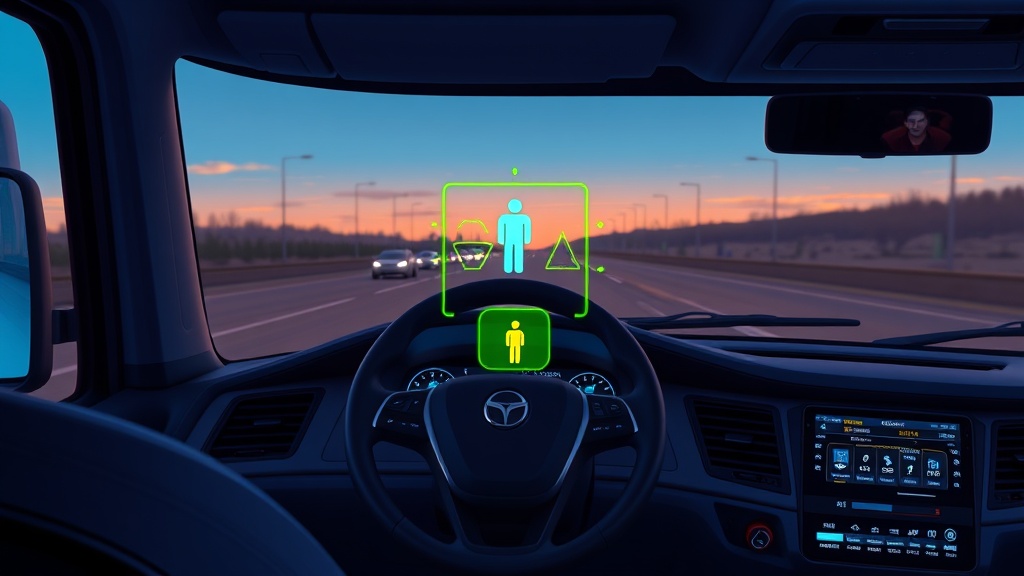
So how does AI actually prevent accidents? It shifts the paradigm from reporting to intervening. Modern systems use computer vision and machine learning to process live video and sensor feeds, interpreting the road and the driver in real time.
This happens through three core functions:
* Computer Vision: Cameras do more than record; they comprehend. They identify pedestrians, cyclists, lane lines, and signage, continuously assessing the threat level around the vehicle.
* Real-Time Behavioral Analysis: AI monitors the driver's state, catching signs of distraction (phone use, gaze deviation), fatigue (yawning, head nods), and risky habits like tailgating.
* Predictive Risk Scoring: By fusing vehicle data, driver behavior, and contextual road conditions, the system assigns a live risk score to every mile, highlighting dangerous situations before they escalate.
That's the breakthrough—transforming safety from a post-incident report into a live intervention system. The payoff is a steep drop in preventable collisions, which directly protects your drivers, reduces costs, and streamlines operations.
In practical terms, AI prevents fleet accidents by analyzing real-time video and sensor data to identify imminent risks—like a distracted driver approaching a pedestrian—and providing immediate audio-visual alerts to enable corrective action before an incident occurs. This proactive intervention is proven to reduce preventable collisions by 30–50%, according to industry data from leading telematics providers.
Crunching the Numbers: The ROI of Prevention
Any major investment needs a clear financial rationale. Understanding the cost of implementing AI for fleet safety monitoring is step one, but the real story is in the payback. Think of this as your ROI calculator for AI-powered fleet safety automation.
What You'll Invest:
* Hardware: AI-enabled dash cams (typically dual-facing).
* Software/Platform: Subscription fees for the analytics portal, video storage, and reporting tools.
* Integration: Technical work to connect the AI system with your existing Fleet Management Software (FMS).
* Change Management: Resources for driver training, communication, and program oversight.
What You'll Save (The ROI Framework):
The return compounds across several areas:
1. Fewer Accidents: This is the biggest lever. Proven AI safety systems cut preventable collisions by 30–50%. Apply that reduction to your average accident cost—including repairs, cargo claims, liability, and downtime—and the savings are immediate and substantial.
2. Reduced Insurance Premiums: Insurers now offer 5–15% discounts for fleets using verified AI safety tech, as it lowers their risk exposure. Major insurers like Progressive Commercial and Travelers have established formal discount programs for fleets with AI video safety systems.
3. Fuel & Maintenance Efficiency: By coaching smoother driving (less harsh acceleration and braking), AI can boost fuel economy by 5–10% and decrease wear on brakes and tires.
4. Administrative Relief: Automated incident reports with contextual video evidence drastically cut time spent on claims investigations and legal disputes, saving hundreds of hours annually.
Stack these savings against the costs. For most mid-to-large fleets, the investment typically pays for itself in 12 to 18 months, after which the annual savings become a direct contribution to your bottom line. This transforms it from a safety cost into a strategic operational investment.
The financial case for AI fleet safety is clear: by reducing preventable accidents by 30–50% and securing insurance discounts of 5–15%, most fleets achieve a full return on investment within 12–18 months, making it a transformative operational investment rather than a mere cost.
Laying the Groundwork: What to Do Before You Buy Tech
The most advanced AI will underperform without the right human and procedural foundation. Technology enables change; people and process drive it.
1. Win Over Leadership and Drivers: You need buy-in on two fronts. Executives must see the strategic ROI. Drivers need to understand the "why"—that this is a coaching tool for their protection, not a punitive surveillance system. Start with transparent, honest communication.
2. Set Concrete Safety Goals: Define what success looks like with specific metrics. Instead of "improve safety," aim for "reduce forward-collision warnings by 40% in Q3" or "increase the average driver safety score by 25%." These KPIs will steer your pilot and rollout.
3. Audit Your Tech and Data: Review your current FMS, telematics, and IT infrastructure. Check their API capabilities and data formats. Clean, accessible data makes integration far simpler.
4. Define Your Coaching Philosophy: Decide how you'll use the AI insights upfront. The most successful programs use alerts for positive reinforcement and targeted training, fostering a culture of continuous improvement instead of blame.
The Implementation Checklist: 8 Steps to Deployment
Follow this sequence to de-risk your rollout and build a program designed for long-term success.
Step 1: Choose AI Features That Match Your Risks
Not every feature is a must-have. The best AI safety features for commercial truck fleets in the US target the most common and severe risks:
* Forward Collision Warning (FCW): Non-negotiable for highway and dense urban traffic.
* Lane Departure Warning (LDW): Critical for preventing drift-related incidents, especially on long hauls.
* Distracted & Fatigued Driving Detection: In-cabin AI that spots phone use, smoking, eating, and signs of drowsiness.
* Predictive Risk Analytics: Learns individual driver patterns and route risk profiles to enable proactive schedule or route adjustments.
* Hard Braking & Harsh Cornering Detection: Pinpoints specific behaviors for focused coaching.
Align your feature selection with your most frequent accident types and operational pain points.
Step 2: Launch a Controlled Pilot
Avoid a risky, full-scale launch. Start with a pilot group—perhaps your highest-risk drivers based on existing telematics, or a team of volunteer "driver ambassadors." This controlled start lets you:
* Validate the ROI in a contained setting.
* Refine your coaching and review workflows.
* Create internal success stories and advocates who can champion the technology to their peers.
Step 3: Integrate AI Data into Your FMS
AI safety data reaches its full potential when it lives in your central Fleet Management Software. This integration creates a single source of truth. Confirm your AI vendor offers robust API connectivity to your FMS. This allows safety events and driver scores to auto-populate driver profiles, letting managers connect safety performance with metrics like fuel use, on-time delivery, and maintenance needs.
Step 4: Train Your Drivers Before Turn-On
Drivers shouldn't learn about the system on rollout day. Build a thorough onboarding program that covers:
* The "Why": Re-emphasize the protective, coaching purpose of the technology.
* How It Works: Explain what the cameras detect, what triggers alerts, and how the data is used.
* The Feedback Loop: Detail how coaching sessions will work, who leads them, and the positive, improvement-focused approach.
An informed driver is an engaged driver, which skyrockets adoption and lowers resistance.
Step 5: Build a Consistent, Positive Coaching Ritual
This is where culture shifts. Establish a regular cadence—weekly or bi-weekly—for safety managers to review AI-generated reports and video clips. Hunt for coaching moments, not just violations. Use positive reinforcement for improved scores. Frame conversations collaboratively: "The system flagged a distractedmoment. Let's review the clip together to see what was happening and discuss strategies to stay focused."
Step 6: Scale Up with Refined Workflows
After a successful pilot (typically 60-90 days), begin your phased rollout to the entire fleet. Use the lessons learned to optimize your processes. Adjust training, clarify coaching protocols, and ensure your management team is ready to handle the increased volume of data and driver interactions.
Step 7: Establish a Continuous Review Cycle
Implementation isn't a one-time event. Schedule quarterly business reviews to assess your key safety KPIs against the goals set in your groundwork phase. Analyze trends, identify new risk patterns, and share success stories across the organization. Use this data to iteratively improve your coaching programs and operational policies.
Step 8: Leverage Data for Strategic Decisions
Move beyond daily coaching. Use the aggregated, anonymized insights from your AI system to inform higher-level strategy. Identify consistently high-risk routes for schedule or contract adjustments. Pinpoint specific vehicle types that may be contributing to incidents. Use driver performance trends to refine hiring profiles and training curricula. This transforms safety data into a competitive advantage.
Navigating the Pitfalls: Common Implementation Mistakes
Even with a solid plan, avoid these frequent missteps that can derail your program’s success:
* Treating AI as a "Set-and-Forget" Solution: The technology provides the alerts, but human-led coaching creates the change. Under-investing in manager training and coaching time is the fastest way to nullify your ROI.
* Leading with Punishment: If the first use of video evidence is to assign blame for an incident, you will destroy driver trust and adoption. Establish and communicate a clear "just culture" policy that focuses on systemic improvement and only uses footage for punitive action in cases of severe, reckless misconduct.
* Ignoring Data Overload: AI systems generate vast amounts of data. Without defined workflows and key metrics, managers can drown in alerts. Use the platform's filtering and scoring tools to focus attention on the highest-risk events and trends.
* Skipping the Pilot Phase: A full-fleet rollout without a controlled test is a high-risk gamble. The pilot phase is your opportunity to work out technical kinks and cultural friction on a small scale.
The Future-Proof Fleet Starts Now
The transition from reactive telematics to proactive AI safety is no longer a speculative edge—it's a core component of modern, resilient logistics operations. The roadmap is clear: build a foundation of people and process, select technology targeted at your specific risks, implement with a focus on positive coaching, and continuously leverage data for improvement.
The result is a tangible reduction in human suffering and financial loss. You gain a powerful shield against the catastrophic costs of a major accident and build a culture where safety is a visible, data-driven, and shared responsibility. The journey begins with a single step: defining not just what you want to prevent, but what you want to achieve.