AI Purchase Order Automation ROI Calculator Guide for 2026
Learn to calculate AI purchase order automation ROI with our 2026 guide. Includes hidden costs, 3-step framework, and real-world savings for healthcare, logistics, and real estate.
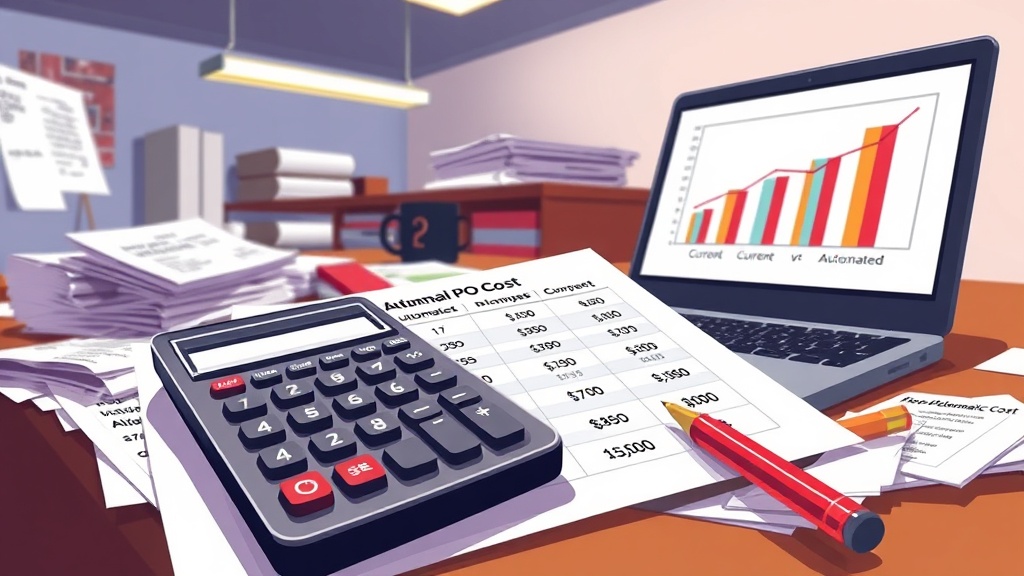
Every manual purchase order costs your business between $12 and $30 to process — and that's before accounting for errors, delays, and late payment penalties. According to Ardent Partners, companies processing 500 POs per month could be spending over $90,000 annually on manual processing alone. The real question isn't whether you can afford AI purchase order automation — it's whether you can afford not to.
An AI purchase order automation ROI calculator is essential for making informed investment decisions. This guide walks you through exactly how to calculate your ROI using an AI purchase order automation ROI calculator, what costs to measure, and what real companies are saving across healthcare, logistics, and real estate.
What Is an AI Purchase Order Automation ROI Calculator?
An AI purchase order automation ROI calculator is a financial modeling tool that estimates the net savings a business can achieve by replacing manual PO processing with AI-powered automation. Unlike generic ROI calculators, this one is procurement-specific — it accounts for the unique cost structures and inefficiencies of manual purchasing workflows. It's designed to help decision-makers quantify the purchase order automation benefits that directly impact their bottom line. By applying the Deming cycle (Plan-Do-Check-Act) to procurement, businesses can systematically measure and improve their purchase-to-pay process.
> What is the core formula for an AI PO automation ROI calculator?
> The core formula is: Cost savings = (Current manual costs) + (Error costs) + (Delay costs) – (Implementation costs + Ongoing costs). The true value comes from customizing each input to your specific operation, capturing hidden costs that generic tools miss.
Why You Need a Procurement-Specific ROI Model
Generic ROI calculators miss PO-specific metrics like error correction time, approval cycle bottlenecks, and supplier relationship costs. A standard business ROI model might calculate labor savings alone, but procurement has hidden cost layers that only surface when you map the full purchase-to-pay cycle. Consider this: a single invoice matching dispute can cost $200 per hour to resolve, and duplicate payments eat 0.5–2% of total PO spend. Industry research suggests that businesses often overlook 40–60% of their total procurement costs when relying on generic models.
What the Calculator Considers
A proper AI purchase order automation ROI calculator includes the following inputs:
- Monthly PO volume
- Average PO value
- Current error rates (manual POs average 10–40%)
- Manual processing time per PO
- Software implementation costs
- Ongoing maintenance and training expenses
The Hidden Costs of Manual Purchase Orders (And How to Measure Them)
The hidden costs of manual purchase orders include data entry errors (costing 2–5% of PO value), approval delays (reducing early payment discounts by 30–50%), and supplier relationship friction from inconsistent processing. Most businesses only track direct labor hours, missing 40–60% of total costs. Understanding your manual PO processing cost is the first step toward building an accurate ROI model. The Toyota Production System, known for its focus on eliminating waste, identifies these as classic "Muda" (non-value-adding activities) that directly erode profitability.
> What are the most commonly overlooked hidden costs in manual PO processing?
> Error-related costs, lost early payment discounts, and supplier friction are the three largest hidden costs. Together, they can equal or exceed direct labor costs, making a baseline calculation incomplete without them.
Direct Labor Costs
Calculate your baseline: Hours per PO multiplied by hourly rate multiplied by monthly PO volume. A logistics company processing 500 POs monthly, spending 15 minutes per PO at $30/hour, is spending $3,750 monthly — or $45,000 annually — just on data entry, routing, and filing. And that's before matching invoices or correcting errors.
Error-Related Costs
Manual PO processing carries a 10–40% error rate, according to ISM data. These errors cascade: duplicate payments, inventory discrepancies, delayed shipments, and strained supplier relationships. The Hackett Group reports that best-in-class procurement teams spend $3.72 per PO versus $18.24 for average teams — AI narrows this gap dramatically by reducing errors to under 1%. Measuring your automated PO approval workflow cost savings starts with quantifying these error-related expenses.
Opportunity Costs
Every late PO approval means a missed early payment discount (typically 2% net 30 terms). For a company spending $500,000 monthly on POs, that's $10,000 in lost discounts each month. Add delayed production from late purchase orders, and the annual opportunity cost can easily exceed $100,000 for mid-size operations.
How to Calculate ROI for AI in Procurement (3-Step Framework)
To calculate ROI for AI in procurement, follow this three-step framework: baseline your current costs, estimate your AI implementation costs, then project your annual savings using industry benchmarks and your own metrics. This structured approach produces a reliable AI procurement ROI figure you can present to stakeholders with confidence.
> How do I calculate ROI for AI purchase order automation?
> Follow a three-step process: 1) Calculate your total annual manual cost (PO volume × cost per PO + error costs + delay costs); 2) Estimate AI implementation costs (typically $30,000–$80,000 for custom solutions); 3) Project annual savings (applying industry benchmarks of 60–80% processing cost reduction). The result is your first-year ROI figure.
Step 1: Calculate Your Baseline
Total annual manual cost = (PO volume × current cost per PO) + error costs + delay costs. A mid-size fleet management company processing 800 POs monthly at $15/PO spends $144,000 annually on direct processing. Add 15% error costs ($21,600) and lost discount opportunities ($36,000), and the true baseline exceeds $200,000.
Step 2: Estimate AI Implementation Costs
Custom AI purchase order automation software typically ranges from $30,000 to $80,000 for development, depending on complexity and ERP integration requirements. Budget additional costs for team training, API connections, and monthly maintenance. Most implementations reach full operation within 6–12 weeks. When you evaluate how to calculate ROI for AI in procurement, include all these cost elements to avoid underestimating your investment.
Step 3: Project Annual Savings
Practitioners report compelling benchmarks: McKinsey reports AI procurement automation reduces purchase-to-pay cycle times by 50–70%. Apply these ratios to your baseline: 60–80% reduction in processing costs, 90%+ reduction in error rates, and 50–70% faster approval cycles. For our fleet management example, a $200,000 baseline with a $60,000 AI investment yields $140,000 in first-year savings — a 233% first-year ROI.
Most businesses see full ROI within 6–12 months, with 3-year ROI exceeding 400% in high-volume environments.
AI Purchase Order Automation vs. Traditional ERP: Which Delivers Better ROI?
AI purchase order automation delivers substantially higher ROI than traditional ERP automation alone because AI handles unstructured data (emails, PDFs, scanned invoices) and adapts to changing supplier rules — capabilities no traditional ERP was designed for. When comparing AI purchase order automation vs traditional ERP, the key difference lies in flexibility and speed of value realization. This distinction aligns with the Baldrige Excellence Framework, which emphasizes process integration and agility as key drivers of superior performance.
> Does AI purchase order automation replace my ERP system?
> No. AI purchase order automation integrates with your existing ERP via APIs without replacing it. AI handles free-form purchase requests, learns approval patterns from historical data, and auto-categorizes line items — all capabilities your ERP wasn't built for. This typically delivers 2–3 times faster payback than a major ERP upgrade.
What Traditional ERP Does Well
ERP systems like SAP, Oracle, and Microsoft Dynamics excel at financial tracking, inventory integration, and compliance reporting. They provide the structural backbone for procurement data management and are essential for enterprise financial operations.
Where ERP Falls Short
According to Gartner, 70% of procurement leaders say their ERP systems fail to handle exceptions without manual intervention. ERPs operate on rigid workflows that break when receiving non-standard purchase requests, email orders, or multi-line invoices with inconsistent formatting. Customization costs are high — a major ERP module upgrade can run $100,000 to $500,000 with 12–18 months to value.
The AI Advantage
Custom AI purchase order automation software integrates with your existing ERP via APIs without replacing it. AI handles free-form purchase requests, learns approval patterns from historical data, auto-categorizes line items, and flags anomalies — all capabilities your ERP wasn't built for. IBM research shows AI-powered procurement reduces exception handling time by 80%.
The ROI comparison is clear: a $30,000–$80,000 custom AI solution delivering value in 6–12 weeks versus a $100,000–$500,000 ERP upgrade taking 12–18 months. AI solutions pay back 2–3 times faster.
Real-World ROI: Industry Examples from Healthcare, Logistics, and Real Estate
Real-world case studies across healthcare, logistics, and real estate show AI purchase order automation reducing processing costs by 60–85% and cutting approval cycle times from days to hours. These AI procurement ROI case studies provide concrete benchmarks for building your own financial model. Clearframe Labs has partnered with 15+ clients across these industries to deliver measurable results.
Healthcare
A hospital network processing 1,200 POs monthly reduced per-PO costs from $28 to $9 — a 68% reduction. The AI system eliminated 15,000 hours of manual data entry annually and dropped approval cycles from 5 days to 4 hours. Estimated annual savings exceeded $275,000 with full ROI achieved in 5 months.
Logistics
A fleet management company with high invoice volumes cut matching errors by 95%, saving $340,000 annually in duplicate payments and dispute resolution. The automated PO approval workflow cost savings extended beyond direct processing — faster approvals meant better supplier terms and reduced fleet downtime from delayed parts orders.
Real Estate
A property management firm automating 80% of vendor PO approvals reduced late payment penalties by $50,000 annually. Supplier relationships improved as consistent automated processing led to better net terms, further compounding savings. The system paid for itself within 8 months.
| Industry | Baseline Cost/PO | Post-AI Cost/PO | Annual Savings | Payback Period |
|---|---|---|---|---|
| Healthcare | $28 | $9 | $275,000 | 5 months |
| Logistics | $18 | $5 | $340,000 | 4 months |
| Real Estate | $22 | $7 | $180,000 | 8 months |
The most common pitfall when estimating AI purchase order automation ROI is underestimating hidden manual costs — many businesses only count direct labor hours, missing 40–60% of total costs tied to errors, delays, and supplier friction. Even businesses considering AI purchase order automation for small businesses can fall into these traps without a proper framework. Understanding these pitfalls helps you accurately capture all AI purchase order automation benefits.
> How do I avoid the most common mistakes when calculating PO automation ROI?
> Avoid these five pitfalls: 1) Include error and delay costs in your baseline (not just labor); 2) Budget for API integration, but don't assume a full system overhaul is needed; 3) Plan for a 60–90 day adoption ramp-up; 4) Budget 10–15% of development cost annually for maintenance; 5) For SMBs, consider that even 200 POs monthly can justify a $30,000 AI investment.
Pitfall 1: Counting Only Direct Labor
Error costs, delay penalties, and lost discounts often equal or exceed direct labor costs. Include them in your baseline — the ROI calculator is only as accurate as the inputs.
Pitfall 2: Ignoring Integration Complexity
AI purchase order automation for small businesses may seem daunting, but custom AI integrates with existing ERPs through APIs — it doesn't replace them. Budget for API connections, data mapping, and testing, but don't assume you need a complete system overhaul.
Pitfall 3: Overestimating Adoption Speed
Plan for a 60–90 day ramp-up as teams adapt to new workflows. Training costs and temporary productivity dips are real, but they're one-time expenses against permanent savings.
Pitfall 4: Underestimating Maintenance Costs
AI systems learn over time, requiring model retraining and version updates. Budget 10–15% of initial development cost annually for maintenance and monitoring.
Pitfall 5 (SMB-Specific): Assuming AI Is Too Expensive
Custom AI is now accessible for businesses processing 200+ POs monthly. Even at 100 POs per month, savings of $14,400 annually justify a $30,000 AI investment over a 2-year horizon. The procurement automation software landscape has matured — small businesses no longer need enterprise budgets to compete.
Frequently Asked Questions
What is the typical ROI timeframe for AI purchase order automation?
Most businesses achieve full ROI within 6–12 months, with high-volume environments seeing payback in as little as 4–5 months.
How much does custom AI purchase order automation software cost?
Custom solutions typically range from $30,000 to $80,000 for development, depending on complexity and ERP integration needs, plus 10–15% annually for maintenance.
Can AI purchase order automation integrate with my existing ERP?
Yes. Custom AI solutions connect via APIs to systems like SAP, Oracle, and Microsoft Dynamics without replacing them.
What is the average error rate for manual PO processing?
Industry data suggests manual PO processing carries a 10–40% error rate, which AI can reduce to under 1%.
Is AI purchase order automation cost-effective for small businesses?
Yes. Even businesses processing just 200 POs monthly can justify a $30,000 investment, with annual savings typically exceeding $14,000.
How long does implementation take?
Most custom AI solutions reach full operation within 6–12 weeks, with full adoption achieved in 60–90 days.
Ready to Calculate Your Actual ROI?
The numbers don't lie: AI purchase order automation delivers 60–85% cost reduction, 90% error reduction, and full ROI within 6–12 months for most businesses. But your specific ROI depends on your PO volume, current error rates, and operational complexity.
Rather than guessing, use the three-step framework above to build your own AI purchase order automation ROI calculator. Input your actual numbers — PO volume, processing time, error rates, and labor costs — and see the projected savings for yourself.
If you'd like a custom ROI analysis for your specific PO volume and industry, speak to someone on our team at Clearframe Labs. We'll help you build a precise financial model based on your real operational data, no guesswork required. Clearframe Labs specializes in crafting custom AI applications and workflow automations that deliver measurable results for businesses in healthcare, logistics, and real estate.