AI strategy consulting for healthcare
Learn how to craft a compliant AI strategy for healthcare. Discover whether to build, buy, or partner to achieve real ROI on automation, documentation, and patient intake.
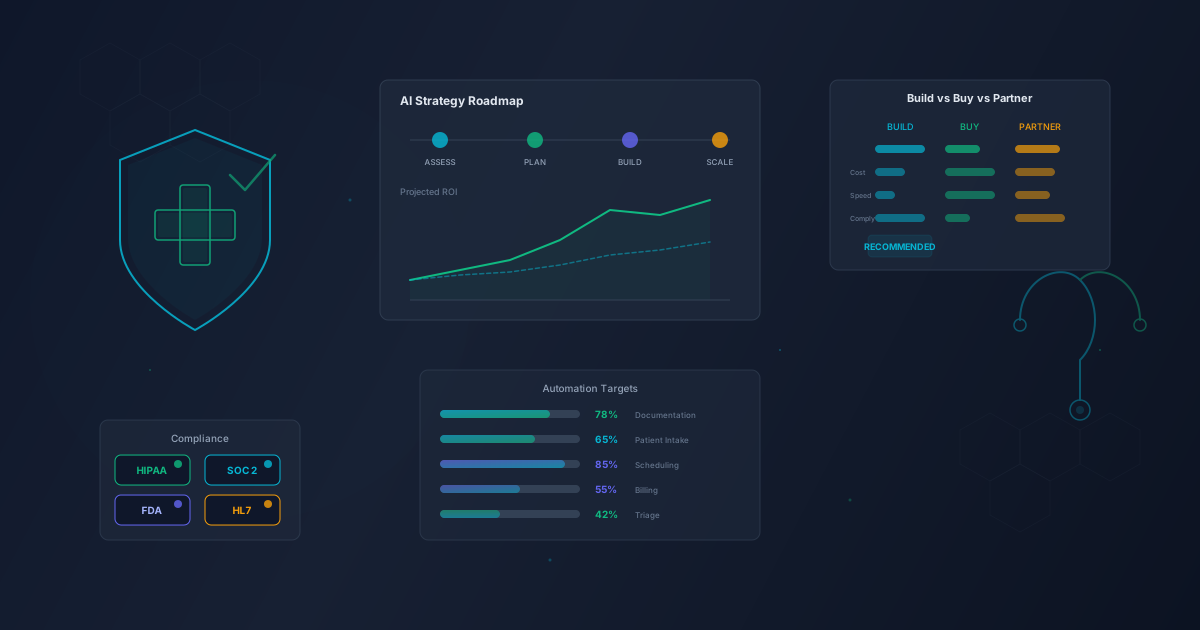
Crafting Your AI Strategy in Healthcare: The Path to Real Impact
Healthcare faces a paradox. Operational costs climb, administrative burnout deepens, and regulatory demands tighten—all while artificial intelligence offers a genuine path forward. However, deploying AI without a unified, compliant plan is a fast track to wasted budgets and new vulnerabilities. Scattered point solutions create data silos, security gaps, and frustrated staff. This roadmap is for healthcare leaders ready to move beyond tools to a tailored strategy. We’ll outline where to begin, how to execute, and how to decide whether to build, buy, or partner for a transformation that delivers measurable returns.
The Case for Strategy Over Software
Providers are under incredible strain. Costs rise, teams are buried in paperwork, and expectations for care quality and data security intensify. It’s tempting to grab a single AI tool promising relief—a scheduling bot or a patient inquiry chatbot. But solving one problem in isolation rarely works.
Without a strategy, the risks are concrete. You could violate HIPAA or other regulations by using tools not designed for healthcare. Systems that don’t communicate fracture patient visibility and hinder efficiency. Worst of all, staff may ignore poorly integrated tools, wasting money and breeding skepticism. A strategic approach ties AI to organizational goals, embeds compliance from the start, and sequences rollouts to build trust and demonstrate value. It turns AI from an expense into an engine for growth.
A strategic AI approach in healthcare is essential because it aligns technology investments with organizational goals while embedding compliance from the outset. According to industry analysis, healthcare organizations that adopt a fragmented, tool-by-tool approach to AI face significantly higher risks of data silos, regulatory violations, and user abandonment. In contrast, a unified strategy sequences rollouts to build staff trust and demonstrate measurable ROI, transforming AI from a cost center into a driver of operational efficiency and care quality.
Build, Buy, or Partner: Navigating Your Options
You need a strategy—but how do you bring it to life? Most leaders weigh three options: building internally, purchasing off-the-shelf software, or partnering with a specialist. Your choice hinges on resources, timeline, and the level of customization you require.
Building In-House: The Illusion of Control
Building your own solution promises perfect alignment with your workflows. You call the shots on every feature. The reality? This path is notoriously complex and expensive. You’ll need to hire and retain rare, costly talent: data scientists, machine learning engineers, and DevOps experts. Development can drag on for a year or more, delaying any return on investment. Then comes the endless cycle of maintenance, updates, and keeping pace with evolving regulations. For organizations without a deep technical bench, the total cost often becomes unsustainable.
Buying Off-the-Shelf: Fast but Inflexible
Commercial AI software offers speed. Deployment can happen in weeks, which works for generic, widespread challenges. The catch? You get limited customization. These products are built for the average user, which might force you to alter your own processes to fit the software. Integration with your EHR and other core systems can be clunky or incomplete, sometimes creating more manual work, not less. You also surrender control over the product roadmap and data governance to an outside vendor.
Forming a Strategic Partnership: Balancing Customization and Speed
Partnering with a specialized consultancy splits the difference between a custom build and a quick buy. For most healthcare providers wanting a tailored solution without permanent overhead, partnership is the smartest route. A firm with deep healthcare expertise can help pinpoint high-ROI opportunities, develop compliant applications, and manage deployment. This model reduces risk through proven methods and regulatory knowledge while accelerating results—often delivering a working pilot within months. It turns a capital-heavy project into a managed service with a clear ROI trajectory.
For most healthcare organizations, a strategic partnership is the optimal path to AI implementation because it balances customization with speed while avoiding the high costs and talent shortages of in-house development. This model leverages specialized healthcare and regulatory expertise to deploy compliant, high-ROI pilots within months, compared to year-long internal builds. Partnerships convert large capital expenditures into predictable operational expenses with clearer return trajectories, making AI adoption financially sustainable.
The Non-Negotiables: Compliance, Security, Ethics
AI in healthcare doesn’t get a pass on the fundamentals. Compliance, security, and ethics aren’t add-ons; they’re the bedrock of your strategy. A powerful AI tool is useless if it breaches patient trust or legal standards.
Which regulations matter most? In the U.S., HIPAA and HITECH set the rules for protecting patient health information (PHI). Any AI handling PHI needs strict access controls, audit trails, and encryption. Evolving guidelines from the FDA and the ONC are also shaping new standards for AI transparency and fairness.
This is where specialized compliance consulting proves its worth. Beyond regulations, your strategy needs an ethical backbone. That means actively working to mitigate bias in training data, ensuring algorithms are explainable, and upholding clear patient consent. HIPAA-compliant development is just the starting line. You also need strong data governance, security-by-design principles, and plans for ongoing monitoring. Baking this expertise in from day one is the best way to manage risk and build lasting trust.
Compliance, security, and ethics are non-negotiable foundations for any healthcare AI strategy, not optional add-ons. In the United States, HIPAA and HITECH mandate strict protections for patient health information (PHI), requiring encryption, access controls, and audit trails for any AI system handling such data. Furthermore, emerging guidelines from the FDA and the Office of the National Coordinator for Health IT (ONC) are establishing new standards for algorithmic transparency and fairness, making ethical considerations like bias mitigation and explainability critical from the outset.
Where to Begin: Use Cases That Deliver Quick ROI
With a strategy and compliance foundation set, where do you start to show value fast? Target repetitive, time-intensive, error-prone processes. These high-impact areas offer clear returns.
Revolutionizing Patient Intake & Scheduling
Manual patient onboarding is slow and mistake-ridden. AI can transform it. Smart forms, OCR for insurance cards, and 24/7 conversational chatbots collect information automatically. This slashes front-desk workload, cuts data entry errors, and boosts patient satisfaction by reducing wait times. A medium-sized practice could reclaim 15–20 administrative hours each week, freeing staff for meaningful patient care.
Untangling Prior Authorization & Claims
Prior auth and billing are black holes of delay and denial. AI algorithms can review clinical notes against payer rules, auto-populate requests, and submit them electronically. For claims, AI checks for coding errors before submission. Automating these steps can shrink processing from days to hours, speeding up revenue cycles. The ROI comes from lower denial rates, improved cash flow, and redirecting billing staff to handle complex cases.
Transforming Clinical Documentation
Doctors drown in paperwork. AI-powered ambient listening tools can sit in on visits, generating accurate notes and summaries automatically. Clinicians maintain eye contact with patients while ensuring records are complete. The efficiency gain is real—potentially saving 2–3 hours per clinician per day. That directly lowers operational costs by boosting productivity, allowing for more visits or reducing overtime.
Mastering Supply Chain & Inventory
Hospitals waste millions managing inventory. AI analyzes past usage, seasonal trends, and surgery schedules to predict demand accurately. This enables just-in-time stocking, cutting waste from expired items and preventing critical stockouts. The ROI in supply chain automation is often immediate, with many organizations seeing a significant reduction in carrying costs and waste within the first year.
Healthcare organizations should begin their AI implementation with high-ROI use cases like patient intake automation, prior authorization, clinical documentation, and inventory management. These areas target repetitive, error-prone processes where AI can deliver quick, measurable value. For example, AI-driven clinical documentation tools can save clinicians 2–3 hours per day, while automating prior authorization can reduce processing time from days to hours and significantly lower claim denial rates, improving cash flow.
Your Implementation Playbook: Start Small, Scale Smart
A great plan means nothing without execution. Adopt a phased “crawl, walk, run” approach to build confidence, prove value, and create a template for growth.
Phase 1: Discovery & Audit
Start by mapping the landscape. Hold workshops with clinicians, administrators, and IT staff to document processes, pinpoint pain points, and gather data. The aim is to select the highest-value, lowest-risk pilot project. This phase sets your direction, defines key metrics, and secures buy-in across the organization.
Phase 2: Pilot Design & Build
With a target chosen, develop a Minimum Viable Product (MVP). In a custom engagement, this means building a focused application—like an automated intake tool or prior auth assistant. This stage involves integrating with your EHR, training models on your de-identified data, and designing user-friendly interfaces.
Phase 3: Test, Learn, Refine
Deploy the pilot to a controlled group. Measure everything against your KPIs: time saved, errors reduced, user satisfaction. Listen to end-user feedback to uncover adoption hurdles. Then refine the solution based on real-world data. This iteration ensures the tool actually solves the problem before a wider rollout.
Phase 4: Scale & Integrate
Once the pilot demonstrates clear value and user acceptance, plan your expansion. Roll out the solution to more departments or locations, develop training programs, and establish support. Deepen integration with your enterprise data systems. The lessons learned will also help prioritize your next AI initiatives, building a sustainable pipeline for innovation.
A successful healthcare AI implementation follows a phased "crawl, walk, run" playbook, starting with a focused pilot project to demonstrate value before scaling. This approach begins with a discovery phase to identify high-impact, low-risk opportunities, followed by building a Minimum Viable Product (MVP) for a controlled test group. After refining the solution based on real-world KPIs and user feedback, organizations can then plan a wider rollout, using the lessons learned to build a sustainable pipeline for future AI initiatives.
Frequently Asked Questions (FAQ)
What are the biggest risks of implementing AI in healthcare without a strategy?
The primary risks include violating regulations like HIPAA, creating data silos that fracture patient visibility, and poor staff adoption that wastes investment. A fragmented, tool-by-tool approach often leads to security gaps, compliance failures, and skepticism among clinicians and administrators, undermining potential ROI.
Should my healthcare organization build, buy, or partner for AI solutions?
For most providers, a strategic partnership is the optimal choice. Building in-house requires rare, expensive talent and can take over a year, while buying off-the-shelf software offers speed but limited customization. Partnering with a specialized firm balances customization with accelerated deployment, often delivering a compliant pilot within months without permanent overhead.
Which AI use cases deliver the fastest ROI in healthcare?
High-ROI starting points include automating patient intake and scheduling, streamlining prior authorization and claims processing, transforming clinical documentation with ambient listening tools, and optimizing supply chain inventory. These areas target repetitive, time-intensive tasks where AI can quickly reduce errors and free up staff for higher-value work.
How do I ensure AI compliance with regulations like HIPAA?
Compliance requires embedding security and privacy from the design phase. Any AIhandling PHI must implement strict access controls, encryption, and audit trails. Partnering with a firm that has deep healthcare regulatory expertise is the most reliable way to ensure your systems are built and maintained to meet HIPAA, HITECH, and evolving FDA or ONC guidelines.
How can we build staff trust and encourage adoption of new AI tools?
Involve end-users—clinicians, nurses, and administrators—from the very beginning. Use the pilot phase to gather their feedback and refine the tool to fit their workflows. Transparent communication about the tool's purpose, how it protects data, and the tangible benefits it provides (like time savings) is crucial. Demonstrating quick wins from an initial pilot is the most powerful way to build broader trust.
What does a realistic timeline look like for an AI pilot project?
With a strategic partnership, organizations can often move from initial discovery to a deployed pilot in 3 to 6 months. The timeline depends on the complexity of the use case, data integration requirements, and the scope of the MVP. The key is to start with a tightly defined project to generate momentum and prove value quickly.
Conclusion: From Concept to Sustainable Impact
The promise of AI in healthcare is real, but it is not realized by technology alone. It is achieved through deliberate strategy. By moving beyond isolated tools to a unified plan, you align innovation with your core mission. Choosing the right implementation path—often a strategic partnership—balances the need for customization with the urgency of results. Grounding every step in unwavering compliance and ethics builds the trust required for adoption. Starting with a high-ROI pilot creates a proof point that fuels organization-wide transformation.
The path forward is clear: define your strategy, secure your foundations, start with a focused win, and scale with confidence. This disciplined approach transforms AI from a buzzword into a durable driver of efficiency, clinician satisfaction, and superior patient care. The future of healthcare belongs to leaders who act not just with urgency, but with intention.