AI tools for marketing directors
Learn how to implement custom AI marketing tools for enterprise directors. Our strategic guide covers ROI, implementation, and overcoming data integration challenges.
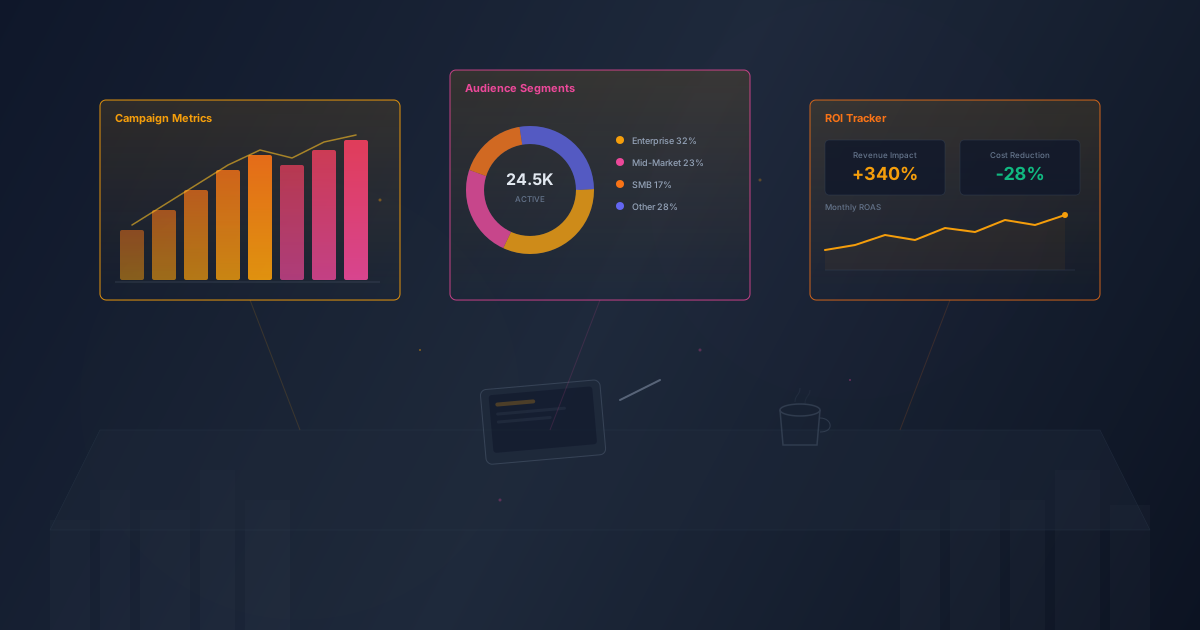
Strategic Guide to Custom AI Marketing Tools for Enterprise Directors (2024)
Enterprise marketing directors face immense pressure to deliver personalized, scalable campaigns with clear ROI, yet generic tools consistently fall short. Off-the-shelf solutions promise intelligence but deliver rigidity, forcing teams to contort unique processes into a vendor’s predefined box. The result is fragmented data, missed opportunities, and a marketing engine that can’t keep pace. This guide provides a strategic roadmap for evaluating, implementing, and scaling custom AI marketing tools for enterprise directors. The objective isn’t merely to adopt AI—it’s to build a proprietary marketing system that grows smarter and more valuable every quarter.
Why AI is a Non-Negotiable for Modern Marketing Leadership
AI in marketing has evolved from a speculative trend to a strategic necessity. Enterprise leaders are no longer asking if they should adopt AI, but how to embed it into operations before competitors pull ahead. Consider the driving forces: customers now expect hyper-relevance, data volume has exploded beyond manual analysis, and automated competitors are moving at a pace manual teams cannot match.
Inaction carries a real cost. Marketing teams relying on intuition and spreadsheets are watching a widening performance gap. They miss micro-opportunities in customer journeys, personalize clumsily if at all, and see their time-to-insight stretch from days to weeks. Early adopters are seeing a different reality. By automating data synthesis and predictive analysis, they are shifting from reactive reporting to proactive strategy. Tasks that once took weeks now happen in hours. That agility is quickly becoming the hallmark of market leaders.
For enterprise directors, implementing custom AI marketing tools is essential to close the performance gap with competitors. These proprietary systems automate data analysis and campaign orchestration, transforming marketing from a reactive function into a proactive growth engine. Companies that delay adoption risk falling behind as customer expectations for personalization and speed continue to rise.
Navigating the Landscape: Custom AI Development vs. Off-the-Shelf SaaS
Every director faces a fundamental choice: build or buy? This AI vs. traditional marketing analytics comparison 2024 comes down to control, integration, and long-term value.
Off-the-shelf SaaS platforms promise a quick start, but their “one-size-fits-all” design often introduces more problems than it solves. They create data silos, leaving marketers to juggle disconnected dashboards. Integration with legacy systems—like a proprietary CRM or supply chain database—is often clunky or impossible. Their algorithms are generic, trained on broad-market data that doesn’t reflect your unique customer behavior, which limits predictive power and erodes any potential competitive edge.
Custom AI development flips the script. You build a tool that fits your workflow and ambitions. It delivers tailored workflows, proprietary algorithms trained on your data, and seamless integration into your existing tech stack. The initial investment is usually higher, but over three to five years, the total cost of ownership often favors custom solutions. You escape recurring, escalating license fees for features you don’t need and gain an asset that appreciates as it learns. The control over data security, logic, and future scalability is unmatched.
| Feature | Off-the-Shelf SaaS | Custom AI Development |
|---|---|---|
| Control & Customization | Limited to vendor settings | Complete, tailored to specific processes |
| Data Integration | Often creates silos; limited API flexibility | Designed for seamless, unified data flow |
| Algorithm Relevance | Generic, broad-market models | Proprietary, trained on your unique data |
| Initial Cost | Lower upfront (subscription) | Higher upfront (development) |
| Long-Term Cost (3-5 yrs) | Cumulative, often increasing fees | Fixed development, lower ongoing costs |
| Scalability & Future-Proofing | Dependent on vendor roadmap | Built to evolve with your strategy |
The High-ROI Use Cases You Should Pilot First
Move from theory to action by focusing on areas where AI delivers fast, measurable returns. A successful pilot builds internal credibility and can fund broader expansion.
Automating Complex B2B Campaign Orchestration
B2B campaign orchestration is a maze of touchpoints across long sales cycles. The best AI tools for B2B marketing campaign automation act as a central nervous system. Imagine a custom solution that integrates data from webinars, content engagement, CRM interactions, and intent signals to perform predictive lead scoring. It could dynamically prioritize accounts ready for sales outreach and trigger personalized email sequences automatically.
Go a step further: a custom engine can manage dynamic content assembly, generating tailored case studies or proposal sections based on a prospect’s industry and specific pain points. The efficiency gains are tangible. Automating these manual tasks can cut the time marketing and sales ops spend on workflow management by 20-40%, freeing them to focus on strategy and creative work.
The Transformative Power of AI-Driven Segmentation
Traditional segmentation—based on demographics or firmographics—is losing effectiveness. AI-driven customer segmentation for large companies uses machine learning to analyze thousands of behavioral signals in real-time, forming dynamic micro-segments that constantly evolve.
Consider a common scenario: a corporation markets a suite of products to diverse enterprise clients. A traditional model might segment by “industry” and “company size.” An AI model could identify segments like “companies in rapid expansion showing high engagement with scalability content but low usage of advanced feature X,” or “high-value legacy clients with declining engagement, signaling churn risk.”
This precision changes everything. Marketing shifts from blasting generic messages to orchestrating hyper-relevant nurture streams for each micro-segment. The ROI of AI-driven customer segmentation ties directly to campaign performance. Deliver the right message to the right audience at the right moment, and companies often see campaign revenue lifts of 10-30%. Better relevance and timing also boost customer satisfaction and lifetime value, compounding returns over time.
AI-driven customer segmentation uses machine learning to analyze behavioral data, creating dynamic micro-segments that boost campaign revenue by 10-30%. This method surpasses traditional demographic segmentation by identifying real-time patterns like churn risk or expansion readiness, enabling hyper-personalized marketing at scale.
Your Step-by-Step Framework for AI Implementation
A successful AI initiative needs structure, not just software. This how to implement AI in marketing strategy step-by-step framework breaks the journey into manageable phases.
1. Audit & Goal Alignment: Start with a ruthless audit of your current martech stack and processes. Where are the biggest pain points—slow reporting, weak personalization, inefficient lead management? Then set specific, measurable goals. Instead of “improve personalization,” target “increase email click-through rate by 15% within segment Y by Q3.” Pursue low-hanging fruit that promises quick wins to secure buy-in.
2. Data Foundation & Integration: AI is only as good as its data. This phase is about clean, accessible, unified data. Map all your data sources—CRM, marketing automation, web analytics, ad platforms—and plan to integrate them via APIs into a centralized data lake or warehouse. This isn’t glamorous, but it’s non-negotiable. It’s the bedrock.
3. Pilot Program Design: Pick one high-ROI use case to pilot. Keep it tight and time-bound—for example, a 90-day pilot for AI-driven segmentation in email marketing. Define success metrics, required data inputs, and the team involved. A focused pilot minimizes risk and delivers a clear proof of concept.
4. Development & Deployment: Now you execute. Whether building internally or partnering externally, use agile methodologies. Work in sprints to develop a minimum viable product (MVP), test it, gather feedback, and iterate. Choose partners who listen and ensure the solution integrates smoothly with your operations.
5. Measure, Learn, and Scale: Once deployed, measure the pilot’s performance against your KPIs. Analyze what works and what doesn’t. The goal is learning and refinement. After a successful pilot, build a scaling roadmap to apply the AI capability to other channels, regions, or business units—using the same disciplined process.
Implementing AI in marketing requires a five-phase framework: audit, data integration, pilot design, development, and scaling. Starting with a focused 90-day pilot on a high-ROI use case, like segmentation, minimizes risk and provides a clear proof of concept before broader deployment.
Overcoming the Real Challenges: Data, Talent, and Integration
Planning for hurdles separates successful implementations from failed experiments. These are the core challenges of scaling AI in corporate marketing departments and how to tackle them.
Data Silos: The most common roadblock. Marketing data often lives in isolated platforms. The solution? Advocate for an API-led architecture. Work with IT to create a unified customer data platform (CDP) or data warehouse that acts as a single source of truth, pulling from CRM, marketing automation, web analytics, and even offline sources.
Talent Gap: Most marketing departments lack machine learning engineers. The build vs. buy vs. partner decision is critical. Building a team is slow and expensive. Buying off-the-shelf has clear limitations. Partnering with a specialized consultancy strikes a balance—providing immediate expertise without the long-term overhead of a full team, freeing your staff to focus on strategy and adoption.
Integration Headaches: Legacy systems won’t vanish. The key is upfront planning. During the design phase, audit every system that must connect to the new AI tool. Choose development partners who emphasize flexible, API-first development and have experience building interfaces for diverse enterprise systems. Smooth integration is half the battle.
The primary challenges in scaling AI for marketing are data silos, talent gaps, and legacy system integration. Solving these requires building a unified data foundation via APIs, partnering with experts to fill talent shortages, and selecting development partners with proven enterprise integration experience.
How to Calculate and Prove the ROI of Your AI Investment
To secure budget and maintain executive support, translate AI’s impact into financial terms. Build an ROI model that quantifies both cost savings and revenue generation.
Start with all development costs, internal or external. Then calculate efficiency savings from automation. If an AI tool automates 15 hours per week of manual work for a team of five, that’s 3,900 hours reclaimed annually. Multiply that by your team’s blended hourly rate for a hard efficiency dollar figure.
On the revenue side, attribute uplifts directly to AI initiatives. If your segmentation pilot increased email campaign revenue by 18%, calculate the total incremental revenue. Add improvements in other revenue-influencing metrics, like higher lead conversion rates or increased customer lifetime value from better personalization.
A strong ROI model projects these gains over a 3-5 year horizon, comparing the cumulative value of a custom solution against the recurring costs of SaaS alternatives. Frame it as a choice between perpetual expense and appreciating asset. License fees are a cost. A custom tool becomes a proprietary asset that grows in value and defensibility.
A well-constructed ROI model demonstrates that custom AI marketing tools are not an expense but a capital investment. By quantifying efficiency gains from automation and revenue uplifts from personalization, enterprises can project a 3-5 year return that typicallyoutperforms the total cost of ownership for off-the-shelf SaaS subscriptions. This financial case is critical for securing executive buy-in and long-term funding.
The Future-Proof Enterprise: Building a Proprietary Advantage
The ultimate goal is not to implement a single tool but to cultivate an AI-native marketing organization. This means evolving from using AI for discrete tasks to embedding it into the core strategic fabric. The system you build today should be designed to learn and adapt, incorporating new data sources, channels, and predictive models as they emerge.
This proprietary advantage compounds. Your custom algorithms, trained on your unique data, become a form of intellectual property that competitors cannot replicate. They enable you to anticipate market shifts, personalize at an individual level, and optimize spend with a precision that generic tools cannot match. The marketing department transforms from a cost center into a data-driven growth engine that actively shapes product roadmaps and customer experience.
The path forward requires decisive leadership. Begin by identifying the single highest-friction point in your current operations—the area where data is abundant but insight is slow. Use the framework outlined here to launch a disciplined pilot. Prove the value, secure the resources, and scale systematically. In the age of AI, the greatest risk for enterprise marketing directors is no longer making a wrong choice with technology; it is making no choice at all, ceding the competitive edge to those who build their own future.