AI prototype development process
Learn how a custom AI prototype development process validates your idea, reduces risk, and proves ROI before full-scale investment. Get our 5-phase blueprint.
A Practical Guide to Developing Your Custom AI Prototype
You’ve read the reports, sat through the strategy sessions, and heard the buzz. Your business needs an AI plan—but the gap between wanting one and implementing something useful feels vast. The fear is real: committing serious budget to a project that never delivers. What if you could test the waters before diving in? That’s exactly what a custom AI prototype development process lets you do.
This isn’t about building a flashy demo that collects dust. It’s about creating a working, testable asset that proves your idea has merit—before you invest major time and money. Consider this your straightforward playbook. We’ll cover why starting small makes business sense, clarify the stages of AI development, and walk through a proven method to turn speculation into a solid investment.
The Business Case for Starting with a Prototype
Jumping straight into full-scale AI development is a high-risk move. Costs run high, requirements grow complex, and returns can feel theoretical. No wonder so many initiatives never leave the boardroom. The real barrier isn’t the technology—it’s the risk. Many AI projects fail because the problem was poorly defined from the start, not because the algorithms weren’t advanced enough.
A custom prototype changes that. Think of it less as a preliminary step and more as a risk-management tool. It turns abstract potential into something you can interact with and evaluate, all for a fraction of the cost of a full build. You get to answer critical questions with evidence: Will this tool actually save my team 30% of their time? Can it reliably predict equipment failures? A focused prototype delivers those answers.
Financially, it’s a smart move. The investment in a prototype is modest compared to a full-scale project, yet it provides the clarity needed to avoid a far more expensive mistake. This phase is where you start quantifying real benefits—like cutting 20–40% from repetitive tasks or spotting specific cost savings in operations. In short, a prototype trades uncertainty for evidence, turning a gamble into a calculated next step.
A custom AI prototype is a focused, testable version of an AI tool built to validate core functionality and user value before full-scale development. It typically takes 4 to 12 weeks to develop and serves as a critical risk-management step, allowing businesses to confirm technical feasibility and ROI potential with a modest initial investment.
PoC vs. Prototype vs. MVP: Getting Your Terms Straight
Words matter, especially when aligning your team. Proof of Concept (PoC), Prototype, and Minimum Viable Product (MVP) are often used interchangeably, but they mark different stages in your AI journey. Knowing the difference keeps everyone focused and manages expectations.
Proof of Concept (PoC): Testing the Tech
A PoC is your technical feasibility check. It’s a narrow experiment to answer one core question: Can we actually build this? For example: Can a model classify these images accurately enough? Can we connect this new tool to our old system? A PoC is usually built without polish, meant for a technical audience. Its outcome is a simple yes or no—does the core technology work?
Prototype: Testing the Value
This is where strategy meets execution. A prototype takes a proven concept and asks a broader set of questions: Should we build it this way? Does it deliver real value? It pairs a working AI model with a basic user interface—often a wireframe or simple app—to test how people will use it. You’re validating the workflow, gathering feedback, and de-risking the product direction before engineering a full MVP.
Minimum Viable Product (MVP): Testing the Market
An MVP is the first real version of your product. It’s stable, functional, and ready for early adopters to use in a live setting. Built with production-ready code, security, and scalability in mind, its purpose is to test market adoption and begin generating value. Think of it as a de-risking funnel: the PoC checks the tech, the prototype validates the user experience, and the MVP proves the market fit.
The key distinction is that a Proof of Concept (PoC) tests if an AI idea is technically possible, a Prototype tests if it delivers user value and has a viable workflow, and a Minimum Viable Product (MVP) is a market-ready version used to validate business adoption. This staged approach, as outlined by industry frameworks like the AI maturity model, systematically reduces risk at each step.
A 5-Phase Blueprint for Your AI Prototype
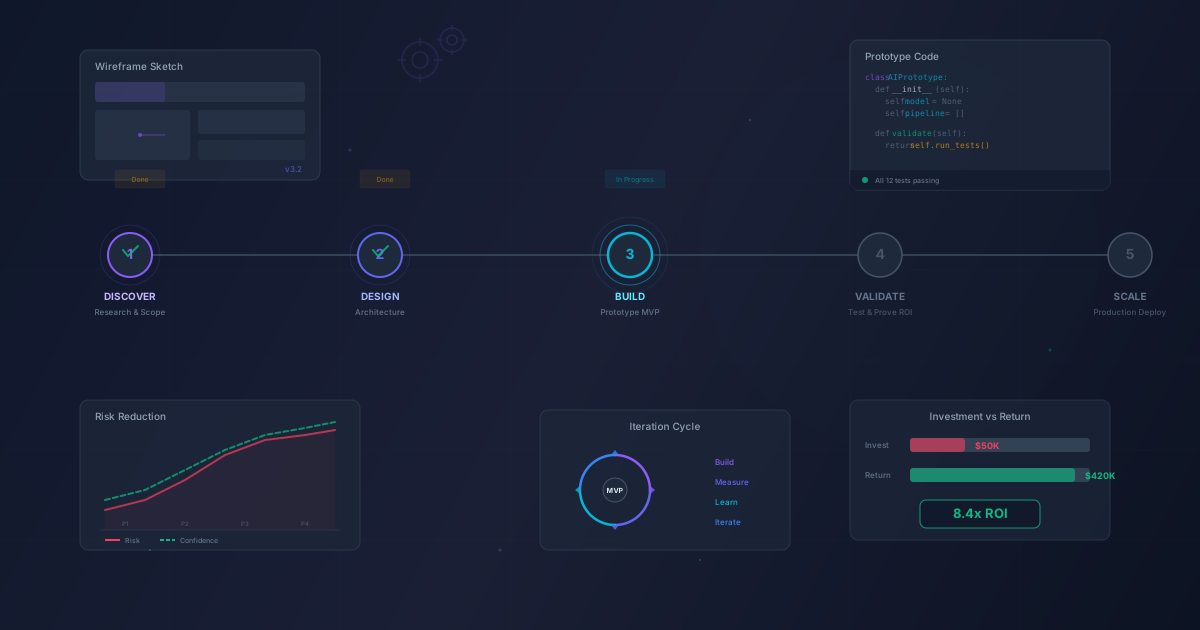
Turning an idea into a validated prototype requires a structured approach. At Clearframe Labs, we follow a disciplined custom AI prototype development process designed to maximize learning and minimize risk. Here’s how it works.
Phase 1: Discovery & Scoping
Start with alignment. We move from a general interest in “AI” to a specific business objective. Workshops with your stakeholders help define the actual problem, the people it affects, and what success looks like. We set clear KPIs—like “reduce manual data entry by 35%” or “improve lead scoring accuracy by 25%”—and begin modeling the estimated ROI. The goal is to frame everything around tangible value from day one.
Phase 2: Data Audit
AI runs on data. This phase is critical: we audit your available data—its sources, quality, structure, and volume. Is there enough clean, relevant data to train a model? Does it contain the right signals? This audit often uncovers necessary cleaning or integration work. Succeed here, and you de-risk the entire project before any code is written.
Phase 3: Design Sprint
With a validated problem and viable data, we plan the build. This collaborative sprint involves selecting machine learning algorithms, designing user flows and wireframes, and outlining the technical architecture. The output is a clear blueprint that both your team and our engineers agree on.
Phase 4: Build & Iterate
Now we create the working prototype. Engineers build the application framework and integrate the AI models. Using a subset of your prepared data, we train initial models to a “good enough” accuracy level to demonstrate core value. This phase is highly iterative, with constant internal testing to refine functionality and user experience. The result is an interactive prototype, not just a static design.
Phase 5: Validation & Roadmap
Time to test. We run structured sessions with your actual stakeholders or end-users. Does the tool solve their problem? Is the interface intuitive? We measure results against the KPIs from Phase 1. Finally, we deliver a comprehensive report and a go/no-go roadmap outlining the steps, timeline, and investment needed to scale the prototype into a full MVP or production application—complete with refined ROI projections.
A structured 5-phase process—Discovery, Data Audit, Design Sprint, Build & Iterate, and Validation—is a proven method for developing an AI prototype. This approach emphasizes defining clear KPIs upfront and validating the prototype with real users, which according to best practices in agile AI development, significantly increases the likelihood of project success and ROI realization.
Where Prototypes Deliver Real Value: Workflow Automation
The best way to understand a prototype is to see it in action. Here’s how it translates into intelligent workflow automation across different fields.
Marketing teams might prototype a tool for dynamic customer segmentation. Instead of static lists, the prototype analyzes real-time engagement to segment audiences and generate personalized content. It validates the automation logic that could drive campaign efficiency and higher conversions—before investing in a full marketing suite.
Logistics and fleet managers often grapple with unexpected vehicle downtime. A prototype could build a predictive maintenance model, analyzing historical sensor data from a sample of the fleet to accurately flag high-risk vehicles. This proves the concept for an automation that schedules maintenance proactively, highlighting major cost savings from avoided repairs and better asset use.
Photographers and studios frequently face a post-production bottleneck. A prototype could automate culling and basic editing by learning a photographer’s past selections and style. It demonstrates the ability to shortlist the best shots and apply baseline corrections—validating a workflow automation that cuts hours per project and frees up capacity for more clients.
In each case, the prototype acts as a focused experiment. It validates the core automation logic and user acceptance, providing a low-risk path to scaling a high-ROI solution.
AI prototypes for workflow automation can validate efficiency gains in areas like marketing segmentation, predictive maintenance, and content processing. By testing a core automation logic with real data and users, businesses can confirm potential time savings of 20-40% on repetitive tasks before committing to a full-scale build.
Timeline and Investment: Setting Realistic Expectations
Let’s be clear about what this takes. A custom AI prototype is a strategic project, not a quick fix.
A typical AI prototype development timeline runs 4 to 12 weeks, depending on complexity. A simpler workflow automation might lean toward the shorter end; a more complex computer vision or predictive analytics tool will take longer, especially if data preparation is involved.
Cost varies based on a few key factors: the complexity of the AI models, the state of your data (a major time driver), the level of custom interface design, and the depth of integration with existing systems. Frame this not as an expense, but as a strategic investment in de-risking. You’re buying three things: clarity (a validated concept), certainty (a proven ROI path), and a functional asset (the prototype itself) that can evolve directly into a production solution.
Developing a custom AI prototype typically requires 4 to 12 weeks, with the timeline heavily influenced by data readiness and solution complexity. The investment is strategically justified as it de-risks larger projects by providing validated evidence of technical feasibility and user value before major capital allocation.
Frequently Asked Questions (FAQ)
Q: What is the main purpose of an AI prototype?
A: The primary purpose of an AI prototype is to validate the core value proposition and user experience of an AI idea with minimal investment. It tests whether the solution solves a real problem effectively before committing to full-scale development, thereby reducing technical and financial risk.
Q: How is an AI prototype different from a Proof of Concept (PoC)?
A: A Proof of Concept (PoC) is a technical test to see if an AI model can be built to perform a specific task. An AI prototype builds on a successful PoC by adding a user interface and workflow to test how people will use the tool and whether it delivers tangible business value.
Q: What are the typical outcomes after a successful AI prototype?
A: Following a successful prototype, teams receive a validated concept, user feedback, performance data against KPIs, and a clear roadmap. This roadmap outlines the steps, timeline, and investment required to develop a Minimum Viable Product (MVP) or a full production application.
Q: How much does it cost to develop an AI prototype?
A: The cost of developing an AI prototype varies significantly based on data complexity, model sophistication, and interface needs. It is a strategic investment focused on risk reduction, typically representing a fraction of the cost of a full-scale build, with thevalue derived from the clarity and de-risking it provides.
Q: What kind of data do we need for an AI prototype?
A: You need a representative sample of the data the final solution would use. This includes historical data for training models and sample inputs for testing. The data should be relevant to the problem, but it doesn't need to be perfectly clean or integrated at the outset; part of the prototype's purpose is to assess and plan for necessary data work.
Q: Who should be involved in the prototype development process?
A: Key stakeholders from both business and technical teams should be involved. This includes product owners, end-users who understand the problem, data engineers or IT staff familiar with your data sources, and executive sponsors. A collaborative approach ensures the prototype addresses real needs and practical constraints.
Your Next Step: From Idea to Evidence
The path from an AI idea to a tangible business result doesn't have to be a leap of faith. By starting with a custom prototype, you replace speculation with evidence. You gain a working model that demonstrates real potential, aligns your team, and provides the concrete data needed to make a confident investment decision.
The process outlined here—from precise scoping and data auditing to iterative building and user validation—is a proven framework for mitigating risk and maximizing learning. It turns the abstract promise of AI into a practical, actionable project.
If you have a process to optimize, a decision to automate, or a customer experience to enhance, the most strategic move is to start small and learn fast. A prototype is that critical first step, transforming "Can we?" and "Should we?" into a clear, evidence-based "Here's how."